Sunday, December 30, 2012
Holiday drinking
I've been off from work the past week hanging out at home with my family and enjoying the break by trying some beers, wines and punches that I've been waiting for special occasions to open/make. Some of these have been duds, unfortunately, others have been amazing -- top 10 drinks of all time. I'm not going to go through detailed tasting notes for all of these (mostly because I didn't take them for some of these -- was enjoying food & drink & company).
Let's get started --
For Christmas, I got a bottle of St. George Absinthe Verte, one of my favorite booze bottles. It's intensely fennel flavored -- like Greek ouzo -- and has lots of herbal notes that make themselves apparent as you let this spirit open up with a bit of ice and water. I could drink a little of this every night and be very happy.
For Christmas, I made a bourbon pecan molasses glazed ham, and popped a Bluxome St. Winery Russian River Pinot Noire that I bought from the SF-based winery. This is one I didn't take notes on -- too busy cooking and entertaining -- but essentially I liked it because it didn't taste like a typical RRV PN. Those, in my mind, are dense, dark-fruit driven wines, lots of cola notes, that aren't as ethereal as what a Burgundy can be. This bottle was a perfect complement to the ham -- it stood up to the sticky sweet glaze without overwhelming it. I really enjoyed this bottle -- I'm remembering cranberry and cherry notes, a very light wine but totally enjoyable.
Before I popped that bottle, I did create a punch from a recipe from Charles Dickens, via David Wondrich. This was the first warm punch I've made -- the others have been iced and drunk in the summer time. The punch is a combination of rum from the west indies, brandy (I was cheap and went with Korbel VSOP instead of Cognac, which costs tons more), sugar, water and lemons. Overall, everyone liked this, it felt warming and poured from the crock pot hot, but my impression was that the lemon and alcohol were the biggest components coming through. Like any warm alcoholic beverage, you're going to taste the alcohol instead of the other flavors it might have (on the other end, ice diminishes its taste). As this punch cooled, my affection for it grew. Next time, I think I'll make it the same way (I liked how lighting the whole bowl on fire for a few minutes drew out the oil from the lemon peels) and just let it naturally cool down and serve it that way with a big block of ice.
Finally, on the beer side of things I went to Beer Revolution with my brother in Oakland and tried a bunch of odd and exciting things. My favorite by far was the Labyrinth Black Ale by Uinta Brewing Company. Weighing it at 13.2 percent ABV, this is a massive imperial stout, but it's so sweet and intense, it definitely stood out from the 6 glasses we shared. Lots of coffee notes, black licorice, molasses and dark chocolate. I've seen this beer for sale for about $13 at Whole Foods, and plan on picking up a few bottles to save. Would be perfect on a really cold day, or with BBQ (maybe super bowl party pairing?) or even just with desert.
Hope everyone enjoyed their holiday drinks as much as I did!


Wednesday, December 12, 2012
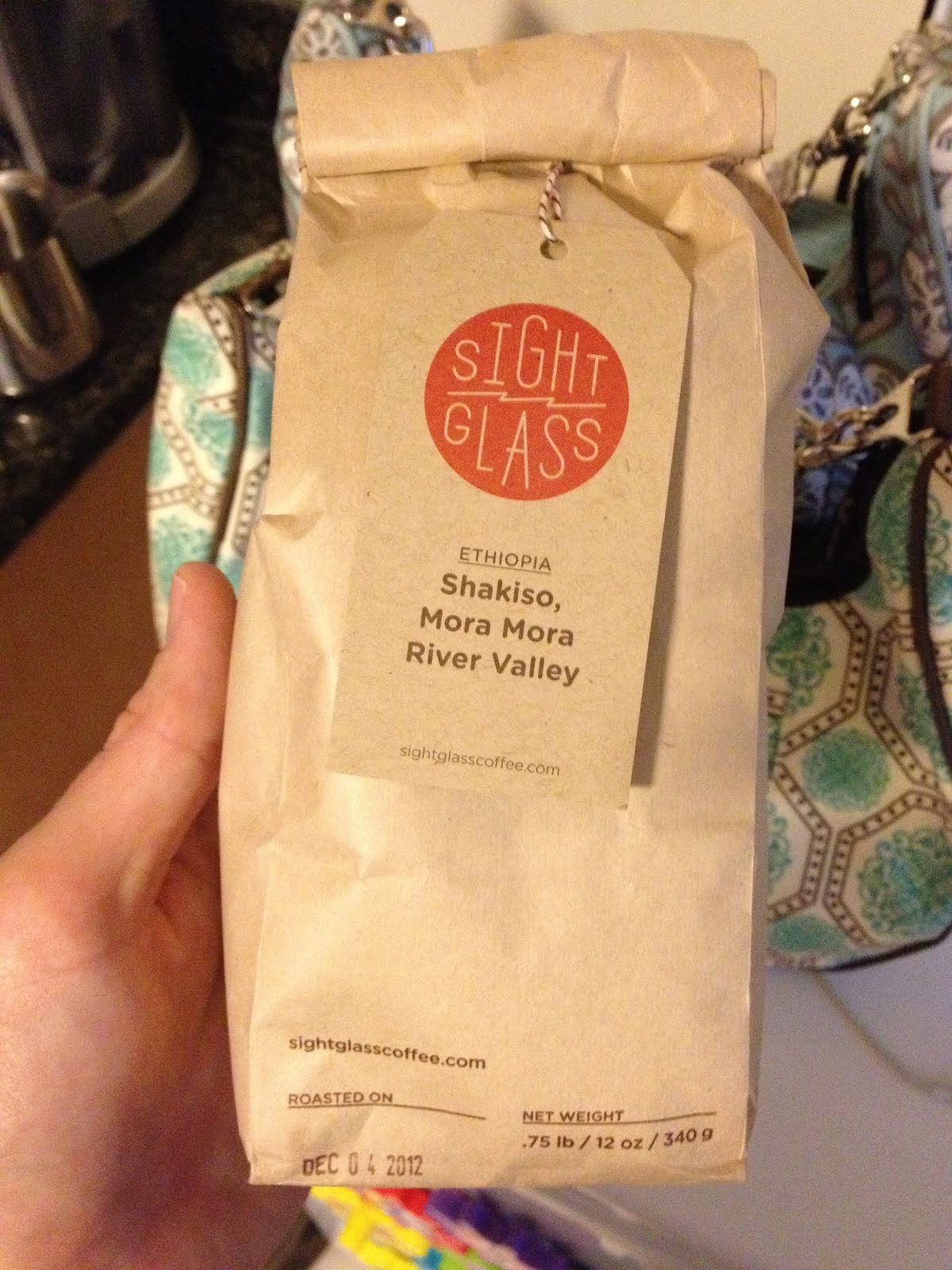
Sight Glass Ethiopia Shakiso, Mora Mora River Valley
Saturday, December 1, 2012
$7 cup of coffee at Starbucks?
And not some foo-foo drink either -- legit coffee. It's the Geisha varietal, originally from Ethiopia and lost for decades until it reappeared in Panama early last decade (or, more accurately, re-classified) and became world renowned a few years ago when it sold for an astounding $100+ at a specialty coffee auction. I detailed a cool experience I had drinking this in 2008 with George Howell at Terroir Coffee outside of Boston.
My tasting notes at the time read: "Very light in color, and looked tea-like in its transparency. That comparison was apt because the smell and taste reminded me of Darjeeling tea. That was followed by a striking citrus flavor that mellowed out to a buttery richness in the finish. Beautiful."
Starbucks is not going to be selling this coffee. What they are selling is a geisha from the farm of Costa Rica Finca Palmilera. They're also going to be brewing it in their Clover coffee machine, a high precision box that allows the user to control the temperature down to the tenth of a degree and seep time down to seconds. It was the darling of the third wave roasters until Starbucks bought the business and then people started pissing on them for it. But it's still a great innovation for coffee brewing.
I tried to get a cup of this special coffee last week in San Francisco but the Starbucks near my office didn't have it yet; they said try next week. While I'm excited to see what this tastes like, my concern is that like most of their coffees, including their specialty brews for the clover, it will be over roasted and charred. In lieu of the geisha coffee, I got a sun dried Ethiopian, one of my favorite types of coffees. It was just ok -- acidity was lacking, and the flavors were a shadow of sun dried (ie - "natural" processed beans) that I've had at small roasters who take a much lighter touch. But still very curious to see how this Costa Rican turns out.
Saturday, November 24, 2012
T-day recap
Ended up bringing a Torrontes, a rose from the Loire, and an Anderson Valley pinot noir. The Torrontes didn't get opened, as the hosts had already popped a Kendal Jackson Chardonnay, which was quite lovely, and a super bargain at around $10. Food & Wine came to the same conclusion in their recent issue. Generally speaking, I avoid wines made this widely, since they usually overdo the oak (or oak chips, put in bags that are soaked in the wine, instead of more expensive oak barrels) and end up tasting like popcorn butter straight from the spigot. This wine was very lovely though, aged in French Oak (imparts more subtle hints of vanilla and other spices than American oak), with a good balance of tropical fruit, vanilla and baking spices. I'd like to buy a case of this as a house white.
The rose was forgettable -- as they usually are.
The red was a non-vintage pinot noir from Lazy Creek Vineyards. Didn't expect too much from this wine either but it was a pleasant surprise -- light, great acidity, perfect match for the smogasborg of food without being flashy or getting in the way.
Tuesday, November 20, 2012
Thanksgiving
OK, this is going to be a lame post. Lame because every wine columnist publishes a Thanksgiving column about what to drink during this holiday, and they either ALWAYS recommend Riesling and Pinot Noir, or try to find some obscure varietal that wine hipsters are currently hot on. This year, I bet it's white zin -- and not the crappy kind, the new hipster bottle being made by Christina Turley. It's something wine geeks like me are excited about because it's so contrarian -- high end white zine! You can only get it at the winery, or at restaurants like A16. A friend of mine visited the winery and got me a bottle -- they're not too expensive, about $20 each. I've been holding on to mine to try with another hipster favorite, a foodie version of mac & cheese or grilled cheese. What better combo than two typically low brow items done upscale?
Sorry for the tangent -- back to T-day. We're going to a relative's house, and my task is to bring a light app and wine. I'm also on a tight budget with three kids, so I need to find good values that can also impress. Ideally, I'd like to bring three bottles -- a sparkling wine, a rich white or rose, and then a red. Preferably a J Vineyards sparkler, maybe a Jordan Chard, and then a Beaujolais But I have to rely on what I already have on hand. So that probably means a Torrontes, a Barolo and perhaps a sweet Bordeaux dessert wine (white).
Still figuring it all out though.
Wednesday, November 14, 2012
Some misses
Two bottles in a row! Not fun. I'm talking about opening wine that totally....sucks. Just bad. And not bad, but foul, very off.
Both bottles are ones I got at a discount store. One has been pretty good in the past, but this particular bottle, a grenache from Australia, tasted sour, and very bubbly. I've drunk a lot of wine, and plenty of bad wine, but this was just awful. Spit it out, dumped it. Because the wine tasted a little like fermenting wine, I'm assuming that the fermentation got stuck and never finished off.
The second was a cab, also from Australia (trend?) It didn't start off bad, but the finish just fell apart -- had a figgy, flat flavor that seemed like it was ruined somehow.
My powers of description are failing me tonight, but trust me, none of these were worth trying again. Hate wasting wine though.
Monday, November 12, 2012
Should you decant?
Yes! I should just end this post here, but to expand briefly -- decanting can add elements to a wine that aren't present initially when you pop the cork. Sometimes there's a foul odor or off flavors that disapate, other times the exposure to oxygen can bring more life to the wine.
I wanted to post this as an add-on to what The Reverse Wine Snob said on his site yesterday -- see here.
The key thing I wanted to point out in his post was that he doesn't review wines until they've been decanted for a day. I tend to drink wines for a few days as well and update my notes as I go along. While this process probably wouldn't work if I was reviewing wines full time for a pub like Wine Spectator or Wine Enthusiast, given the amount of wines they need to taste a year, what you loose in that process is the changing nature of wine over the course of a few hours or days. When you taste, it's a snapshot in that wine's brief exposed life. It's a picture in time that's constantly changing.
I've had numerous wines that tasted bad for a few hours or even a day, not revealing themselves until enough air had been able to work it's magic. And I've had wines that I liked better four days later (although rare). Without waiting, or with a quick sip and spit, as critics often do at big tastings (myself included) you can sometimes miss the gems.
Just something to keep in mind.
Thursday, November 8, 2012
Amazon Wine
Looks like Amazon is finally selling wine. The company announced a few years ago it was going to make a big push in this area, but after looking at the logistics -- needing to have warehouses in many states, dealing with prohibition-era laws and regulations in a state-by-state basis, they decided to pull out. So apparently they think they have figured it out. Just checking out the site, you see that they are starting to deliver to some states right now, and will likely expand to more later. I also see they have a broad selection of variatels -- 25 tannats! and some big names as well, like Hall, Flora and Coppola.
The key is, will they be able to compete with Wine.com -- which just made its first profit after a decade in the business last year.
And are online wine buyers (like me) too used to flash sale sites like Wines Til Sold Out, Invino, Lot18, etc that offer steep discounts to pay for anything that seems to be full price?
We'll have to wait and see. Still, more competition can't hurt, so this should be a good thing.
Tuesday, November 6, 2012
Stemware
Been suffering from a bit of a cold this week, so my ability to accurately gauge scents and flavors of wine has been somewhat diminished. Doesn't mean I haven't been trying though!
But wanted to talk about another important aspect of tasting wine -- what you drink it out of. Now some, such as Robert Parker, proclaim Reidel glasses can help a wine express more nuance than, say, a coffe mug. Studies have been done to prove this and they haven't backed up those claims. Still, when you're doing a comparison in person, it's hard not to smell and taste a difference from a proper wine glass versus a plastic cup or some other vessel. Is this simply the mind playing tricks on us?
Whether the effect is real or not, I do like drinking from a wine glass with a big bowl, in order to do a vigorous swirl, and a short stem so it doesn't feel so tall and awkward in my hand. After going through several brands, I have found one that is my personal favorite: Schott Zwiesel Tritan Cru Classic. Not only are they big but delicate, they're also cheap -- roughly $10-$12 a glass. They're also dishwasher safe, unlike some of the higher end Riedel glasses -- one of their $100 stems actually broke while I was carefully hand washing it! Quite the dissapointment.
Sunday, November 4, 2012


Subscribe to:
Posts (Atom)


 Posts
Posts


